
A real Meta campaign for a Melbourne NDIS provider produced 8 leads from an AI-generated video and 6 from a static ad — showing why testing different creative formats can make a measurable difference.
When it comes to Facebook and Instagram advertising, one question comes up regularly:
Do video ads actually perform better than static images?
There’s no universal answer. Different audiences, offers and campaigns can produce very different results.
But a recent Meta campaign we managed for an NDIS provider in Melbourne gave us an interesting real-world comparison.
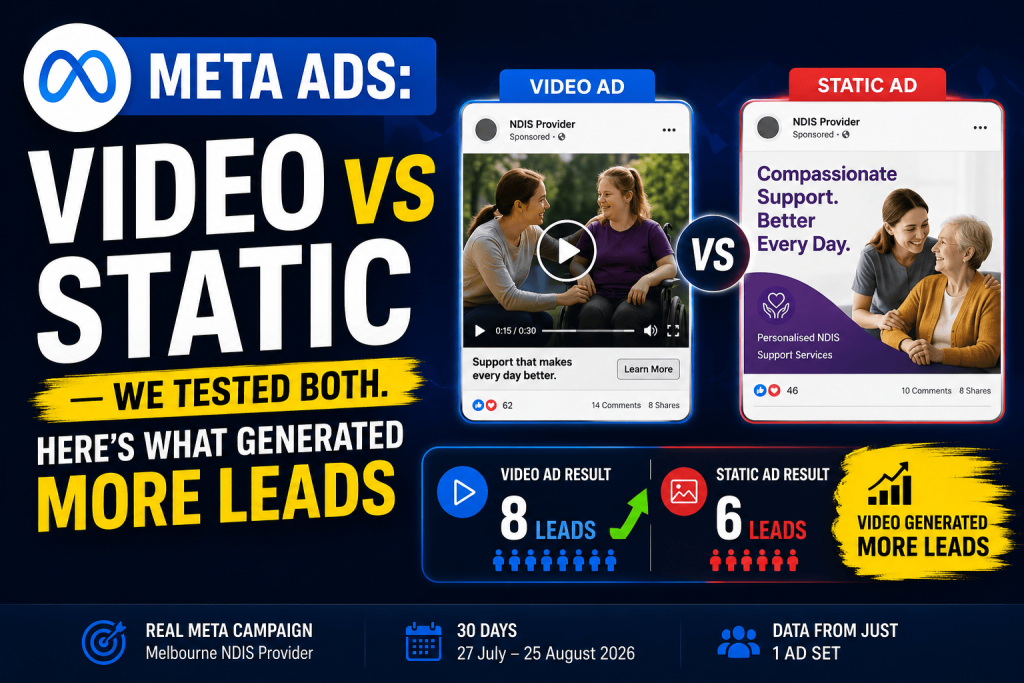
Below is a snapshot of one ad group from a real Meta campaign.
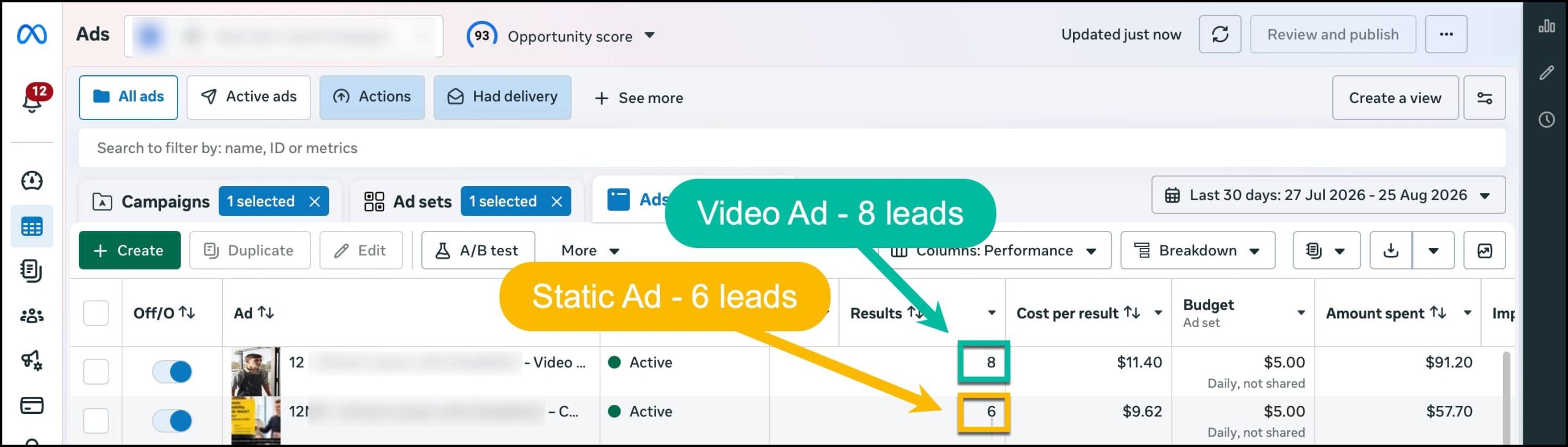
The Campaign
The campaign was running during the 30-day reporting period from 27 July to 25 August 2026, promoting services to prospective NDIS participants and families in Melbourne.
As part of the campaign, we tested several different advertising creatives, including static banners and a short AI-generated promotional video created specifically for Meta advertising.
For this comparison, we’re looking at the results from just one ad set, rather than combining performance across the entire advertising account.
That makes it particularly interesting because the creatives were competing within the same campaign environment.
8 Leads From Video vs 6 From Static
During the reporting period, the two leading creatives within this ad set generated a combined 14 leads:
- AI-generated video ad: 8 leads
- Static banner: 6 leads
That means the video generated approximately 57% of the leads produced by these two creatives, compared with around 43% from the static advertisement.
Put another way, the video generated 33% more leads than the static creative.
For a service-based business where every new enquiry can potentially turn into a long-term client or participant, that difference in lead volume can be meaningful.
But Lead Volume Isn’t the Whole Story
There was another interesting part of the result.
The video generated leads at approximately $11.40 per lead, while the static advertisement generated them at approximately $9.62 per lead.
So although the AI video generated more leads overall, the static banner produced leads at a slightly lower cost.
This is exactly why we generally don’t recommend looking at just one metric — or assuming that one creative format will always outperform another.
The video won on lead volume.
The static ad won on cost efficiency.
And both contributed valuable enquiries to the campaign.
The Video Was Created Using AI
Another interesting aspect of this campaign was that the promotional video wasn’t produced through a traditional video shoot.
We created a short AI-assisted promotional video specifically for the Meta campaign.
This is becoming increasingly useful for small and medium businesses.
Historically, producing video advertising could mean organising filming, locations, talent, equipment and editing — often making video considerably more expensive and time-consuming than creating a static banner.
AI tools are changing that.
Businesses can now create short promotional videos much faster and more cost-effectively, making it practical to test video alongside traditional static advertising even when there isn’t a large production budget available.
The creative still needs to communicate the right message, speak to the intended audience and give people a clear reason to take action.
Why Video Can Work So Well on Meta
Video has several natural advantages in the Facebook and Instagram environment.
People typically scroll through their feeds quickly, which means advertisers have only a short window to attract attention.
Movement can help interrupt that scrolling behaviour.
Video also allows an advertiser to combine:
- visual storytelling
- text and key messages
- people and environments
- branding
- multiple selling points
- a clear call to action
Instead of trying to communicate everything through one static image, a short video can progressively introduce the problem, service and next step.
For an NDIS provider, it can also help make the organisation feel more approachable and give prospective participants or their families a better sense of the support being offered.
Static Advertising Still Works
Importantly, these results don’t mean businesses should abandon static advertising.
Far from it.
The static creative generated 6 leads at approximately $9.62 per lead, making it an effective advertisement in its own right.
Static ads can work extremely well when:
- the message is simple
- the offer is immediately understandable
- the design attracts attention
- there is a strong headline
- the call to action is clear
They can also be faster to produce, making it easier to test multiple concepts, headlines and visual approaches.
Why We Prefer Testing Both
Rather than deciding in advance that every campaign should use video or every campaign should rely on static banners, our preferred approach is to give Meta multiple strong creative options.
For example, a campaign might include:
Video + static banners + different headlines + different messaging angles
The advertising platform can then collect performance data while we monitor which creatives are actually producing enquiries.
Sometimes video wins.
Sometimes static wins.
Sometimes one generates more leads while the other generates them more cheaply.
That’s exactly what happened here.
One Ad Set, 14 Leads From Two Creatives
It’s also worth stressing that the figures above don’t represent every campaign, every ad set or every advertisement we were running.
They come from just one ad set.
Within that single ad set, the two leading creatives generated:
14 leads in total — 8 from the AI-generated video and 6 from a static banner.
That makes the result a useful illustration of why creative diversification matters.
Had we used only the static advertisement, we may have missed the additional enquiries generated by video.
Had we used only video, we would have missed the lower-cost leads coming from the static creative.
The Takeaway
So, are video ads better than static ads?
Based on this campaign, the better question might be:
Why choose only one?
Our AI-generated video produced the greatest number of leads, while the static banner generated leads at a slightly lower cost.
Both worked.
And together, they gave the campaign more opportunities to connect with prospective NDIS participants and their families.
For businesses currently running Facebook or Instagram campaigns using only static imagery, adding short-form video is certainly worth testing.
And with AI making video production considerably faster and more accessible, the barrier to testing it is becoming much lower.
Because sometimes the difference between an average Meta campaign and a stronger-performing one isn’t simply the audience or the advertising budget.
It’s the creative people see first.
Short Promo Videos in Action
Real examples of short-form video creative produced for client campaigns across different industries and services.
What This Means for Your Meta Campaigns
This example shows why creative testing matters.
Within just one ad set, the AI-generated video produced 8 leads, while a static banner generated 6 leads — 14 enquiries from just two creatives.
The video generated the higher lead volume, while the static ad delivered a slightly lower cost per lead. Neither format was the universal “winner” — both contributed to the campaign’s performance in different ways.
If you’re currently running Meta ads using only static images, testing a short promotional video could uncover additional opportunities. And with AI making video production faster and more affordable, it’s now much easier for smaller businesses to test video without committing to an expensive traditional production.
If you’re curious about how we approach Meta campaigns, creative testing and lead generation, I’m always happy to share what we’ve learned from campaigns like this one.
I’m Rusty Gimaev, a Brisbane-based Head of Marketing with 20+ years of hands-on marketing experience, specialising in lean, practical strategies across Meta advertising, lead generation, landing pages, funnels, CRM, follow-up and lead nurturing systems.
I regularly work with service-based businesses, including NDIS providers, to help turn advertising spend into genuine enquiries and new opportunities.
This example is particularly relevant for NDIS providers and other service-based businesses looking to improve Meta campaign performance without simply increasing their advertising budget.
Sometimes the biggest improvement comes from testing the right creative, message and format.
Thanks,
Rusty


